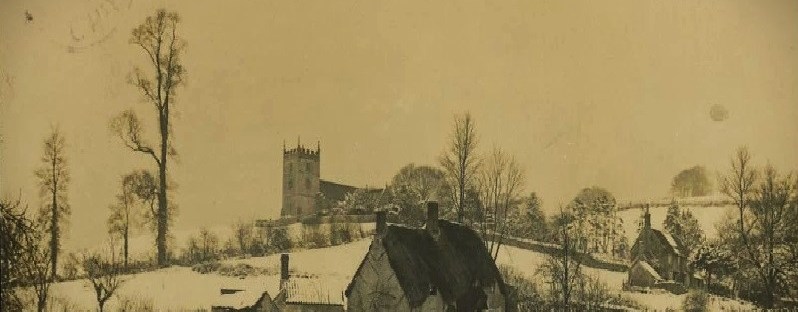
Chapter One Gloucestershire, December 1932 Robert had put on his Sunday-best boots this morning, having polished them with particular care the night before. They were wet from walking through the snow now and he wished he was wearing his old gardening boots with the heavier soles. His suitcase seemed to be gaining weight the further … Continue reading The Best of Intentions
Prisoner number 67
On the 15th of August 1945 my grandad wrote: ‘Awoke about 23.10 & heard guard tell Major Busby that there is no work tomorrow. Rumour that war is over very strong.’ Grandad was a British POW in Hiroshima Camp #6-B at this time. This is his story. My grandad, Kenneth Tonge, had worked in an … Continue reading Prisoner number 67
20 July 1916: ‘They had no chance’
‘Our turn will come if only we can be patient’ Eustace Maxwell, commanding the 23rd Manchester ‘Bantam’ Battalion, wrote to his family on the 16th of July 1916. The Battalion had been in ‘Happy Valley’ (‘here we still sit, bivouacking on the sides of a valley and heartily cursing our luck’) since the 13th of July, and Maxwell … Continue reading 20 July 1916: ‘They had no chance’
‘Something more than a tribute to the dead’: the story of Manchester’s cenotaph
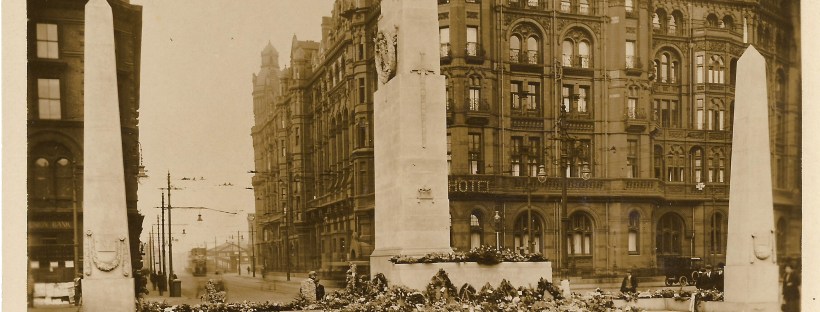
It’s the 11th of November, 1920, and we’re in Albert Square, Manchester. Eleven o’ clock is approaching and the streets are packed. People have climbed onto the monuments in the square, they’re up on the roofs all around, and there are faces in every window. We’re standing next to a journalist from the Manchester Guardian … Continue reading ‘Something more than a tribute to the dead’: the story of Manchester’s cenotaph
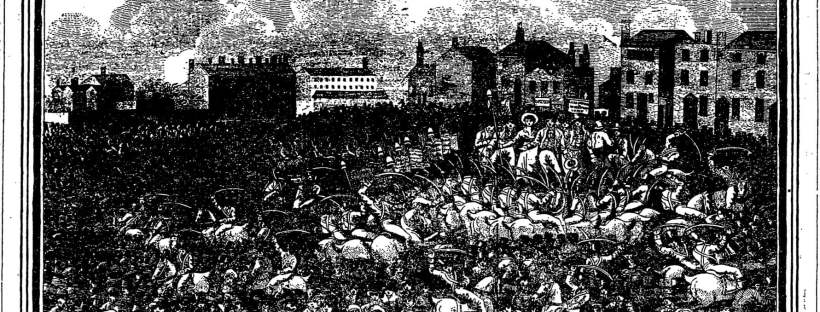
Manchester, 1919: The centenary of Peterloo and the unfulfilled promise
‘Honour the dead, remember the living’ – Peace Day and protest, 19th July 1919
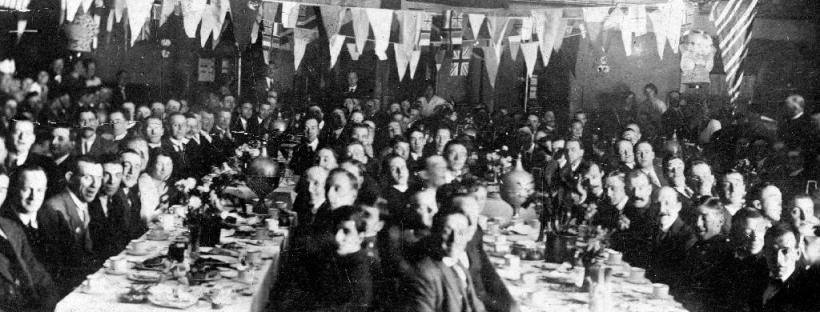
With the treaty negotiations at Versailles finally complete and peace signed at the end of June 1919, a national celebration – ‘Peace Day’ – was fixed for the 19th of July 1919. Plans were announced to light a chain of bonfires down the country (nodding back to the beacons that were lit to warn of the approach of the Spanish Armada on 19 July 1588) and a grand Victory Parade was being prepared for in London.
From the outset, though, there seems to have been some disquiet and confusion as to what ‘Peace Day’ was meant to represent – and whether it ought to be a jubilant celebration or a solemn commemoration. Its reporting in the Manchester papers reflects this ambiguity and the mixed enthusiasm for the project. ‘Anyone who goes outside his house and garden ought to be able to see by this time that the country as…
View original post 1,195 more words
Read Chapter One
EdieLancashire, May 1921 Edie doesn’t hear the postman. She only notices the envelope, there on the linoleum, as she passes through from the kitchen to the sitting room. She bends to pick it up, sure it is a thing of no great consequence, just another bill that will have to wait, until she sees the … Continue reading Read Chapter One
“Lancashire will indeed be proud of them”
Bringing news of the Somme to Manchester, 1st July 1916 (and conveying it back again…)On the 1st of July 1916 Manchester newspapers carried exultant headlines. The Manchester Evening News reported that the British had broken into the enemy forward line over a distance of 20 miles, capturing many prisoners. ‘The public had for some days been led to … Continue reading “Lancashire will indeed be proud of them”